Tuesday, August 22, 2017

Quick Look - Commemorative Series I Reissue Optimus Prime Prototype Prize

I saw this go under the radar on auction in August 2017, under title:
 アメリカ版 試作 景品用 コンボイ オプティマス
(American version prototype for prize Convoy Optimus)

My gut feel was that it was a legitimate prototype/prize figure. I've read previously about similar items - clear plastic versions of reissue figures, and vacuum metallized reissue Seekers - that either served as test-shots (for inspection, fault-finding) or created for promotional prize draws, (or utilised ultimately for both purposes). Read about them here, herehere and here. When it comes to purpose, hearsay is involved, but there is definite, albeit scattered documentation of these types of figures themselves, and they appear to be truly scarce, which actually supports legitimacy (as in not mass produced counterfeits). At the very worst, this is a 'lunchtime special', a clandestine product borne outside official factory hours. At best, this an extremely rare and possibly unique prototype figure that received some extra preparation - custom decal application, additional accessories - in order to be offered as a prize figure

This item was auctioned by the same seller sharbicc who had sold what appear to be contemporary prototypes nearly 10 years ago. Many other signs pointed to it being a legitimate reissue figure, that is it has all the hallmarks of an official reissue Optimus Prime, from the unique wheel pins, bumper moldings and sticker cut, down to the part stamping, and none of the hallmarks of a KO figure (which all are based on a T2/#3 French or Japanese Prime). Also there are no short-stacked counterfeits on the market, so I jumped. Fortunately, nobody else bid and I got it for a song.


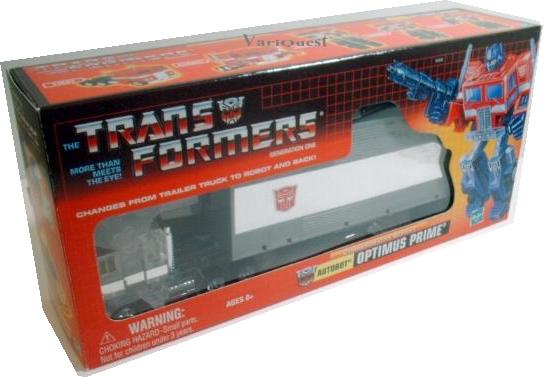
The figure comes in Hasbro Commemorative Series 1 packaging. The mass retail figure was released in 2002.


Opening up the clamshell, you can see that it is the US version cab, with the shortened smoke-stacks for safety. The cab forgoes the die-cast chassis and leg parts, replaced with plastic. The cab is almost entirely a translucent amber plastic. The typically chrome parts remain - wheels, stacks, grill. The trailer is rendered in standard grey plastic, and the amber plastic replaces all the trailer parts that are normally blue. Across the cab and trailer is a glossy chrome sticker trim. Tyres are standard black rubber. I've had discussions with other collectors on Facebook on whether this is intentionally an amber plastic, or it is a clear plastic that has yellowed over the past 15 or so years, which is extremely common (but not omnipresent) among clear toys from this era. On the one hand, it isn't a particularly flattering or attractive choice of plastic. On the other hand it is unusual that roller and the other accessories shown in the baggie are not discolored at all.


Zooming in a little, one can see the Autobot logo on the trailer has been hand-cut and placed on top of the chrome decal. Roller is a clear plastic, and the standard rifle is amber.


Taking a look at the baggie, we have clear plastic wheels for Roller, clear missiles, gas pump and nozzle. There is also a clear bloated rifle and an amber matrix, which were included with the Japanese release 2002 New Year Special Convoy. The hose is a regular black flexible plastic. What is interesting is that a set of 4 black 'safety' missiles are included, which are the longer version exclusive to the US release. This would allow the prototype figure to be potentially offered to different markets, but perhaps the parts considered less safe would have been removed if the figure was used as a prize in the US. Let me tell you, the trailer launcher is absolutely nerfed - there is no spring installed in the launcher at all.


What else was included? The sticker sheet that originated with the 15th Anniversary Convoy of 2000, and a US instruction sheet. I believe this is the standard set-up for the Commemorative Reissue of 2002. I haven't actually owned one until now!

So, it turns out that a figure like this has been sighted somewhere. A photograph of the same setup (but different specimen) is on Fred's page, here. This photograph itself may have been taken as early as 2002, though unsure from where it has been sourced. Though he describes it as a clear trailer, which it isn't, you can see it has the same mirror trailer sticker. This one looks like the cab is clear. Like mine, it hasn't been belted in with wire twists. It has a color break on the flap spine facing the camera, meaning it is not a photograph of my specimen, which has never been opened on that end. Mine was tape sealed both ends and then tape-cut and opened on the far end.
Sunday, June 4, 2017

File Notes - Astro Magnum, Toyco, Intecs, Shockwave, Galactic Man

Many websites that discuss Shockwave's origins state that the original manufacturer, Toyco was and still is a Korean company, and infer that Shockwave is notable for being somewhat of a 'Korean' Transformer, often due to the fact that there is a Toyco Korea website in existence today*. It is true that Shockwave was manufactured in Korea for the Hasbro toyline, among others, however we will explore the history of the toy in more detail here.

In fact, the Toyco in question was and still is a Japanese company. This is the actual website http://www.toyco.co.jp/company.html.


*UPDATE Sept 2024: Note that in 2017 the Toyco Korea URL was operating as Toycomall, and has since rebranded the site around 2022 or so, claiming a 1991 establishment and now displaying the Japanese Toyco logo, which will only reignite confusion for G1 toy freaks. Upon inspection of KIPRIS, the trademark has been registered to the CEO of Toyco Korea, since 1998, when it was wrestled away from Intecs in a judgment around 1996-1997.


Toyco was established in Tokyo, November 20, 1981 and its operations are the business planning, manufacturing and sale of boy's toys. A bit of Trivia, though the head office address has changed several times, Toyco is still located in Tokyo, and has maintained the same telephone number until today, as per the original Astro Magnum packaging of 1983. The initial trademark registration was made on December 9th, 1981, by Katsumi Suzuki, It seems reasonable that he was the initial founder/CEO.

The original Astro Magnum clearly shows a Toyco head office address in Tokyo on the packaging, and both the original 'laser gun' packed version, and the latter 'robot' packed version were manufactured in Japan (as per the box and stamping on the battery cover). The trademark is of course, unmistakable.


The Astro Magnum toys were manufactured in Japan and distributed by Toyco. The original realease bore a maker's mark, 'Toyco', with no copyright notice.


The figure was then licensed to other parties. As we know, Shockwave was initially released to western markets as a Transformer by Hasbro prior to Christmas 1984, and was part of the Japanese toyline in 1985. Radio Shack, a subsidiary of Tandy, also released a version known as Galactic Man at roughly the same time internationally through its network of stores. When the figures were licensed to Hasbro and Tandy, (as well as other US toy companies), it appears that manufacture was off-shored to Seoul, to a manufacturing partner called Intecs, Ltd.. Both Shockwave and Galactic Man are stamped 'Toyco, © 1983' and 'MADE IN KOREA', and there are references to being made in Korea on the packaging and papers included. However only on the back of G1 Shockwave is it clear that the manufacturing partner Intecs, Ltd..


I can only surmise that the manufacturing was moved to Korea for reasons of production capacity or economics. No doubt the contracts with American companies called for high volume at low cost. It is typical that copyrights are sought for legal reasons when a figure is planned to be distributed outside of Japan. Domestic release toys often featured a maker's mark but not a copyright notice. So, it's apparent to me that the appearance of the copyright notice '© 1983' on the toy indicates the involvement of non-Japanese market companies. 

It becomes unclear at this point, who is the licensor to Hasbro and Radio Shack (*see next paragraph), as while Toyco is responsible for the design and manufacture of the original toy, and have acknowledged it here in a roundabout way, there are questions as to what parties have rights to produce and market the toy today, even if the mold's whereabouts were known. Paperwork only refers to Intecs and never Toyco, but Toyco remains the maker's mark on the figures. (Fast forward to today - Hasbro of course would have strong interests in the intellectual property and likeness of Shockwave, though it does not have exclusive rights to the Toyco-G1 toy itself. Hasbro/Takara continues to make toys in the likeness of Shockwave today. And of course, the mold appears to be missing.) Indeed in 1985, Intecs sought to register the Toyco trademark inside South Korea, and held it until about 1997.


*There is a little known variant that has been described (possibly erroneously) as a knock-off called '4 Changeable Spark Man'. It looks like an off-brand Galactic Man, however like G1 Shockwave, it bears the Intecs mark on the packaging, '­© 1983 Intecs Ltd.' and is made in Korea. It also features the Japanese patent registration number as seen on the original Toyco Astro Magnum, as well as patent pending application numbers for other regions: UK/HK, Taiwan, Korea, and USA. (These are not searchable today in patent databases as they are not the the same as the published patent numbers.) This is the key detail that suggests the figure may be a legitimate figure. I believe if I were to find a specimen, it would be a Toyco marked figure. It looks identical to Galactic Man, and has the same foam packaging. It appears that Intecs may have (a) registered copyright on the mold (as a good partner), or (b) was acting as a licensor and/or supplying the figure in grey-market off-brand packaging, (c) actually legally acquired the rights from Toyco to license the figure and was the primary licensor for all figures produced in Korea (being Shockwave and Galactic Man.)


A further knock-off figure called 'Electronic Magnum' looks to have been copyrighted in 1984 by an American entity called S.R. Mickelberg Co., Inc. in PA, USA, who owned the Royal Condor trademark from 1981 to 2005. It appears to be identical to the Spark Man figure, down to the foam and packaging format.


This may offer a clue into the ambiguity of ownership. Several parties appear to have asserted their rights to the toy. Unfortunately, I can not confirm anything until I hold specimens in my hands and perform detailed mold analysis to determine lineage.


Afterword:
During the 80s Japanese toy companies generally made toys in Japan, for Japan. The Takara-developed Transformer toys were all initially made in Japan, and in accordance with the operational and financial realities of distributing the toyline internationally in partnership with Hasbro, certain toys were produced in countries such as Korea, Thailand, Taiwan, Macau, France, and eventually predominantly in China and recently Vietnam. The idea that Toyco is Korean seems to be the result of flawed deduction supported (understandably) by a single piece of erroneous data - the website. 

However, what often isn't discussed is the manufacturing partners that are often responsible for mold tooling and/or manufacture, done on behalf of the toy designer. This adds complexity to understanding the history of some figures. The figure known as G1 Jetfire is one such example, conceived by the legendary Shoji Kawamori and first sold by Watanabe Giken, and commercialized/manufactured by Matsushiro (patented by Yukimitsu Matsushiro in 1984). The Toybox Mechabot-1 figure and its Hasbro-licensed G1 Omega Supreme, were actually designed and manufactured by Tomy on Toybox's behalf. This only became apparent when after Takara-Tomy's merger in the mid 2000s, it was discovered Tomy still had the molds for Omega Supreme and Sky Lynx.

Wednesday, March 22, 2017

Sketch - G1 Wheeljack Fanart


Autobot Engineer Wheeljack
The Transformers, Hasbro Industries, Inc., 1984

Car Robot Lancia Stratos Turbo

Diaclone Real & Robo Series, Takara Co., Ltd., 1982


Italy 1985 Release

Monday, December 26, 2016

Quick Look - Diakron DK-1

In the later half of 1983 Takara had established a spin off of its Japanese Diaclone toyline in the United States through its subsidary Takara US (Takara Toys Corporation), based in New York. The toyline was called Diakron and featured a very limited number of toys from the Diaclone Car Robot series, Dasher series, as well as the multi-vehicle robot Guts Blocker. A Toys-R-Us exclusive, the toyline didn't do particularly well, ostensibly because Takara did not well understand the US market. Ultimately, Takara US's rights to market and distribute the transforming Diakron toys in the US were acquired by Hasbro Industries along with the rights to the bulk of Takara's transforming Diaclone and Micro Change toys in late 1983, to be released as The Transformers the following year. And so marked the the end of the very short and obscure Diakron toyline. Takara US would re-enter the US market with Kronoform, comprising various toys that Hasbro had not used for The Transformers, some featuring Transformers branding, but in the end another unsuccessful and obscure foray into the US toy market.

One of the featured toys, and sequentially the first, was DK-1. Fittingly, it is the same toy as the the first of the Diaclone series, indeed historically the first transforming car-robot ever, the Lamborghini Countach LP500S Super Tuning version. Like the Diaclone, DK-1 was released in red and is the only other release to have done so, making a red variant considerably rarer than it's yellow incarnation; typically G1 Sunstreaker; but also found yellow in the Italian GIG and French Joustra releases, as well as in the Milton Bradley Sideswipe box.


Diakron DK-1 (Front)
Diakron DK-1 (Back)

One of the interesting things about the Diakron release, is that though unsuccessful, many of its packaging details appear to have made it into The Transformers line. The box dimensions are identical in length, height and width to the G1 Autobot cars packaging. Only the height of the box flap differs, being 1 cm shorter on the Diakron. The window placement is identical from the bottom-left co-ordinates and is only slighter taller on the G1. The G1 adopts some of the grey bordering between the window and the character cut-out. And finally both share similar copy, where the Diakron's 'Changes from Racecar to Robot and back!' becomes 'TRANSFORMS FROM RACECAR TO ROBOT AND BACK!' on the G1 packaging.


G1 Sunstreaker (Front)

The internal packaging is quite horrendous. It is a soft, almost vinyl-like plastic tray. It engulfs the toy, making it difficult to see anything more than the side view. In this regard the clear blister arrangement of the G1 is superior. From the back you can see that the tray is in some places only as thin as a supermarket bag. For this reason I haven't dared to remove the toy, as I fear I will do irreversible damage to the tray.


Circle stamped figure with 'Diaclone' pilot
Back of tray

In an interview with Hasbro R&D VP at the time, George Dunsay (Source), he recalled that Diakron did not have many of the elements that made The Transformers successful as a brand - marketing, conflict, commercials. Certainly, the packaging is overloaded with copy, bombarding the viewer with messages about what is inside and how to enjoy it. It is evident that Takara didn't have a good handle on what was required for the market. Hasbro knew how to get people storming into the toy aisles. Diakron looked like a foreign curiosity that you'd be lucky to come across in the first place, let alone be compelled to buy.


Diakron DK-1 (Top)
Diakron DK-1 (Side)

If Takara had scant idea how to sell toys in the US, they certainly acknowledged they needed to find out. The toy was accompanied by a feedback card to ascertain some very rudimentary information about buyers and their impressions of the toyline.


Toy decal sheet and feedback card
Yes, they were really there.

The catalog that doubled as the instruction sheet interestingly didn't feature any other toys from the toyline. Instead, it featured a bunch of penny-racer pull-back cars, known as Choro Q in Japan. Catch some old school commercials for them here, and here.


DK-1 instruction sheet
Penny Racers. A whole different breed of speed.

Even as an example of a poorly executed campaign, the subsequent success and longevity of The Transformers as a global brand have elevated its Diaclone and Diakron predecessors to legendary status. For collectors, the scarcity of the red variant and its historical significance as the pioneering car-robot transforms this obscure piece into an unlikely holy-grail.

Sunday, December 18, 2016

Sketch - Diaclone Countach LP500S Fanart


Car Robot Countach LP500S Super Tuning
Diaclone Real & Robo Series, Takara Co., Ltd., 1982

1983 Takara Direct USA Release

Sunday, December 4, 2016

Sketch - G1 Huffer Fanart


Autobot Huffer
The Transformers, Hasbro Industries, Inc., 1984

Micro Robot Car American Truck

Microman Micro Change, Takara Co., Ltd., 1983

USA 1984 Release

Saturday, December 3, 2016

My Favorites - Autobot Fairladies


ダイアクロン リアル&ロボ シリーズ
Diaclone Real & Robo Series, Takara Co., Ltd., 1983

The Nissan Fairlady 280 ZX Turbo was the basis for three of the twenty-two Diaclone Car Robots. The No. 7 Fairlady Z had two versions, a blue-silver deco, and a silver-black deco. This model was the basis for Bluestreak, who oddly enough sported an entirely new all-silver deco as a Transformer. The No. 11, Fairlady Z Racing and No. 13 Police Car Fairlady Z were both almost identical to their G1 counterparts, Smokescreen and Prowl respectively. The Diaclone-only Fairlady Z decos are extremely rare, highly sought after and very expensive. The Diaclones had spring loaded launchers that fired their missiles a reasonable distance, and a small pilot for added play value.


Car Robot Fairlady Z (Blue)
Japan 1983 Release
(Front)
Car Robot Fairlady Z
Japan 1983 Release
(Back)
Car Robot Fairlady Z Racing
Japan 1983 Release
(Contents)
Car Robot Fairlady Z Racing
Japan 1983 Release
(Front)
Car Robot Fairlady Z Racing
Japan 1983 Release
(Back)
Car Robot Fairlady Z Racing
Japan 1983 Release
(Contents)
Car Robot Police Car Fairlady Z
Japan 1983 Release
(Front)
Car Robot Police Car Fairlady Z
Japan 1983 Release
(Back)
Car Robot Police Car Fairlady Z
Japan 1983 Release
(Contents)

Trasformer, GiG, 1984

At around the same time that Hasbro struck a deal with Takara, GiG had done the same for exclusive distribution in Italy. GiG used a nearly identical packaging format to Diaclone until 1985, when arrangements were made to use the US style Transformers packaging, trademarks, factions etc. In the Fairlady space, this was the only toy-line apart from Diaclone to feature the blue/silver pre-Blustreak. Pre-Prowl was present, as well as Smokescreen. There was no black/silver pre-Bluestreak, only the full silver version as per the US line. As with Transformers proper, there were mold/stamp progressions spanning from the pre-TF circle stamp (see below), to the the Takara copyright with dates.


Auto Robot Fairlady Z Police Car
Italy 1984 Release
(Front)
Auto Robot Fairlady Z Police Car
Italy 1984 Release
(Back)

The Transformers, Hasbro Industries, Inc., 1984


Bluestreak and Prowl both made their G1 debut as series one cars in 1984. As such they can regularly be found with imprints harking back to their Diaclone days. However, even though Bluestreak's boxart suggests a blue G1 version, there was never any blue Fairlady sold in a G1 box. Both Prowl and Bluestreak were released again in 1985, alongside Smokescreen who debuted as a series two car. Smokescreen always sported a rubsign. The US versions had the springs removed from their launchers, rendering them nothing more than missile holders. As sentient robots in the Transformers mythos, the Diaclone pilots were no longer included.

Autobot Strategist Prowl
NGB, ™ box, © 1984 Hasbro Industries, Inc., 5756/5750 ASST
USA 1984 Release 
(Front)
Autobot Strategist Prowl
NGB, ™ box, © 1984 Hasbro Industries, Inc., 5756/5750 ASST
USA 1984 Release 
(Back)
Autobot Gunner Bluestreak
NGB, ™ box, © 1984 Hasbro Industries, Inc., 5755/5750 ASST
USA 1984 Release 
(Front)
Autobot Gunner Bluestreak
NGB, ™ box, © 1984 Hasbro Industries, Inc., 5755/5750 ASST
USA 1984 Release
(Back)
Autobot Strategist Prowl (Diaclone Hood)
™ box, © 1984 Hasbro Industries, Inc., 5756/5750 ASST
USA 1984 Release
(Front)
Autobot Strategist Prowl (Diaclone Hood)
™ box, © 1984 Hasbro Industries, Inc., 5756/5750 ASST
USA 1984 Release
(Back)
Autobot Strategist Prowl
™ box, © 1984 Hasbro Industries, Inc., 5756/5750 ASST
USA 1984 Release
(Front)
Autobot Strategist Prowl
™ box, © 1984 Hasbro Industries, Inc., 5756/5750 ASST
USA 1984 Release
(Back)
Autobot Strategist Prowl
® box, © 1984 Hasbro Industries, Inc., 5756/5766 ASST
USA 1985 Release
(Front)
Autobot Strategist Prowl
® box, © 1984 Hasbro Industries, Inc., 5756/5766 ASST
USA 1985 Release
(Back)
Autobot Tactician Smokescreen
® box, © 1984 Hasbro Industries, Inc., 5953/5766 ASST
USA 1985 Release
(Front)
Autobot Tactician Smokescreen
® box, © 1984 Hasbro Industries, Inc., 5953/5766 ASST
USA 1985 Release
(Back)

Fight! Super Robot Lifeform Transformers, Takara Co., Ltd., 1985 戦え! 超ロボット生命体 トランスフォーマー

Bluestreak, Prowl and Smokescreen were all available in the Japanese G1 release. These releases sported spring loaded missile launchers like their Diaclone predecessors.


Cybertron Strategist Prowl
© TAKARA CO., LTD 1982.
Japan 1985 Release
(Front)
Cybertron Strategist Prowl
© TAKARA CO., LTD 1982.
Japan 1985 Release
(Back)

Transformers Classic, Hasbro (U.K.) 1990

In 1989 Hasbro resumed the production of many of the original Generation 1 toys in Chinese factories, to be distributed for the first time in the Chinese market. These Chinese market releases were released in packaging almost identical to their original G1 counterparts. At the same time, Europe saw re-releases of a number of G1 figures in distinctive gold boxes as the 'Classics' toyline. China received a considerably more comprehensive roster of figures than Europe, however it appears all toys from both lines originated from the same factory production. Of the Fairladies, Prowl was released in both lines, and Smokescreen solely in the Chinese line.


Autobot Strategist Prowl
© Hasbro (U.K.), 1989
Europe 1990 Release
(Front)
Autobot Strategist Prowl
© Hasbro (U.K.), 1989
Europe 1990 Release
(Back)
Autobot Strategist Prowl
Chinese 1990 Release
(Front)
Autobot Strategist Prowl
Chinese 1990 Release
(Back)

Timeline

The items featured on this page have been placed on the Timeline below. Treat it as relative rather than absolute.


Comparisons - Series One and Two Fairlady Zs

Below are Fairlady Z Car Robots and Autobot series one Fairlady Zs that I have photographed for comparison. The exercise is to look at the progression of changes and place the variants on the Timeline.


Typically, Bluestreak had red launchers, Smokescreen white, and Prowl gray. It is logical to expect that the chrome coated missiles and weapon are molded in a plastic matching the missiles. This was true for Diaclone, but the G1 weapons often did not match in this respect, and this can be seen inside sealed paperwork/weapons baggies. It is also possible to observe that the chromed wheels have an underlying color that doesn't correspond to the launchers. For instance Prowl sometimes has red plastic wheels under the chrome.


Three Fairlady Z molds we being used in parallel.


Type 1. The original Diaclone circle stamp can be observed on the early circle stamp Prowl and Bluestreak prerubs. The mold was updated to display a Takara-only copyright stamp on the opposite foot, within a newly added sharp rectangular border, and with the circle stamp text drilled out but still visible in its original placement. The final version has been updated with the Hasbro copyright beneath the Takara copyright. 
The type 1 mold has 2 circles present on each piece of rear bumper. It is usually visible from below, although when it cannot be seen, it is on the top. This means that for example, two right pieces are present and one was flipped to make it a left.


Type 2. The second mold introduced has with a Takara-only stamp on the left foot, with a ridge added to increase the real estate for the stamp. In this case, the ridge is rounded on the corners. There is no imprint on the opposite foot, however the molding seems imperfect, with a slightly angled edge where bevel begins. When the Hasbro copyright is added, this time it is added to the bare foot, so that now a marking is present on each foot. T
ype 2 molds have '2' part numbers stamped on the following places - the fists, the neck (beneath the screw hole that joins it to the roof), and the frame on the underside of the hood that encloses the head arrangement, the shoulders, inside the leg, inside the waist cavity, under the crotch, inside each die cast leg piece near the rear side window. There are no circles on the rear bumper.


Type 3. The third mold was also with a Takara-only stamp on the left foot, with a ridge added to increase the real estate for the stamp. However, the opposite foot also features the same ridge, unlike the type 2. The Hasbro copyright was later added to the right foot. Type 3 molds have '3' part numbers stamped on the following places - the neck (beneath the screw hole that joins it to the roof), and the frame on the underside of the hood that encloses the head arrangement, t
he shoulders, inside the leg, inside the waist cavity, under the crotch. There is no die cast leg piece with '3', some type 3 molds use the '2' piece, and some are stamped '4'. There are no numbers stamped on the fists. There is a circle on each rear bumper, on the short edge.


Top: Type 1 mold lineage from pre-TF to Takara-only to Takara+Hasbro stamp
Middle: Type 2 mold lineage from Takara-only to Takara+Hasbro stamp
Bottom: Type 3 mold lineage from Takara-only to Takara+Hasbro stamp


Left: Type 1 fist (Original Diaclone fist has a large knock dot)
Middle: Type 2 fist has a small  knock dot with '2' inside
Right: Type 3 fist has a small knock dot with no number

Notes on weapons


Weapons are a tricky thing to validate. There's plenty of mixing going on in loose collections, meaning good samples are reduced to that which remain in sealed baggies or unseen in sealed boxes. And then there is factory mixing as well!


Launchers: There are two distinct launcher molds covering Diaclone through to series 2 Smokescreen (ignoring springs). I currently hypothesize that as there are three car molds, there are also three sets of complete weapon molds, and the launchers pictured are types 1 and 3. I have found type 1 launchers in white, red and gray. So far I have only seen type 3 launchers in gray.


Launchers: Type 1 left, type 3 right.

Edit: After some hunting and intense comparison, I believe this is the type 2 launcher. It seems to transition features between types 1 and 3. I have only personally found type 2 launchers in red, though I have identified grey ones on ebay that I am yet to inspect in person.


Type 2 launcher.

Guns: There are three variants, types 1, 2, 3, based on the linear markings on the stock. Type 3 is the basis of the reissue gun as well. Type 2 and 3 feature an improved longer handle.


Missiles: A missile variant appears to have an extra ridge. Have seen this in sealed baggies, where the missile is type 3 - see below. Seen also in the Takara 'Book' Collection reissue, as this appears to use the type 3 mold for missiles, launchers, weapons and figure - however the reissue missiles are enclosed in a 4 sided tree for presentation. The third ridge is always accompanied by a circle mark on the shaft (but not vice versa), I have noted the extra ridge on the standard right angle tree missile (type 3), and also on a mysterious end to end tree missile similar to type 1, but with circle mark. I have not seen this type of missile attached to its tree yet, so this is something to stay tuned for more info.


Missile ridges.

There are three variants of missile tree.

Type 1. Straight - as seen on Diaclones and early G1s, even up to a transitional rubsign Bluestreak, this is a 3 sided tree with sprues connecting each missile tip to end only. This is the most common type as it was used before type 2 and 3 were created, and continued to be used in parallel. Has two ridges. No circle on the shaft.


Type 2. Right angled A - a 3 sided tree with sprues connecting straight to the end, and at right angles to the tip, but with the vestigial stub from the type 1, that no longer connects to the tip. Has two ridges. Has a circle on the shaft.


Type 3. Right angled B - a 3 sided tree with sprues connecting straight to the end, and at right angles to the tip. Has three ridges. Has a circle on the shaft.


Missile trees accompanying Fairladies
Type 1 and 3 found with ™ boxed Bluestreak 
2 found with ® boxed Smokescreen

Problems with matching weapon variants to figure variants.


It is not so simple that the weapon mold types matched perfectly with their figure mold types. See the following sealed baggies:


This accessories pack came from a type 3 mold rub Smokescreen in a ­® box.
Launcher is type 1. Gun is type 1. Missile tree is type 2.
This accessories pack came from a type 2 mold prerub Bluestreak in a ™ box.
Launcher is type 3. Gun is type 3 and gray plastic. Missile tree is type 3 and red plastic.
This accessories pack came from a type 1 mold prerub Bluestreak in a ™ box.
Launcher is type 1. Gun is type 1. Missile tree is type 1 and gray plastic.

Early type Fairladies would always be matched with type 1 accessories, as this was the sole mold in use. Weapons could have been a mix of gray or red plastic under the chrome. However, as the type 2 and type 3 molds came into use, weapons began to be mixed, both in terms of the figure type they were matched with, as well as the weapon types within a baggie. In the last quarter of 1984, when Smokescreen was undergoing production, white plastic parts were also reintroduced. It is a hypothesis that chromed weapons from all three molds may have been combined and then redistributed from the central source for baggie packing on the factory line. 


Exhibit 1A. Fairlady Z (Blue)


Imprint
Manufacturers stampCircle - TAKARA JAPAN
RubsignN/ABumperR 2 ○, 2 ○
F N/A
Other parts stamp
Features
MissilesStraight - T1Foot ridgeNone
Under chromeWhite weapon, missilesCeiling supportStraight
Notes: This specimen is the blue and silver version of the standard Fairlady Z. The spring loaded launchers and the missiles are white, and together fire very strongly. The roof aligns perfectly with the rear windows, due to friction of the piece where it fits into the hood, and has a tendency to slip beneath the rear windows especially as the toy gets loosened from play. There is a support for the ceiling, that in truth is not a support at all - in later G1 iterations a horizontal protrusion is added to hold the ceiling up, forming a right angle support. In the Diaclones it is a straight reinforcement for the side window frame. As a Diaclone, this is a type 1 mold. As the earlier release of the Fairlady, you'll notice there are no rivets molded onto the central wheel-pins. Only the blue/silver and black/silver versions display this (lack of) feature.

Exhibit 1B.(1) Fairlady Z Racing


Imprint
Manufacturers stampCircle - TAKARA JAPAN
RubsignN/ABumperR 2 ○, 2 ○
F N/A
Other parts stamp
Features
MissilesStraight - T1Foot ridgeNone
Under chromeWhite weapon, missilesCeiling supportStraight
Notes: This specimen features a 'RR' sticker on the hood, the initials standing for Real & Robo. The spring loaded launchers and the missiles are white. As a Diaclone, this is a type 1 mold. The wheel-pins feature 4 rivets on each wheel, as do every figure following.

Exhibit 1B.(2) Police Car Fairlady Z


Imprint
Manufacturers stampCircle - TAKARA JAPAN
RubsignN/ABumper R 2 ○, 2 ○
4 ○
Other parts stamp
Features
MissilesStraight - T1Foot ridgeNone
Under chromeGray weapon, missilesCeiling supportStraight
Notes: The Police Car Fairlady features a red 'R' 'DIACLONE' sticker on the hood and doors. It sports gray spring loaded launchers.

Exhibit 1C. Autobot Strategist Prowl


Imprint
Manufacturers stampCircle - TAKARA JAPAN
RubsignNone (Prerub)BumperR 2 , 2 ○
4 ○
Other parts stamp
Features
MissilesStraight - T1Foot ridgeNone
Under chromeRed weapon, missilesCeiling supportStraight
Notes: The very earliest G1 tooling variant of Prowl, it features a 'DIACLONE' hood sticker, however missing the red 'R' of on both the hood and door insignias. Being a USA release, the gray launchers have no springs. It retains the type 1 missile tree seen in the Diaclones. This circle stamped version was only found in straight tech spec boxes, except, strangely, not the NGB box (of which there are two known graded specimens (confirmed by owner of AFA 85 MISB in 2017) (and edit, I located a MOSC specimen for myself on 15/3/2021)). The version found in NGB boxes is circle stamped with a standard hood sticker, as pictured below. NGB Fairladies have a different blister type to the regular release. The adhesive area is cut to align to the shape of the blister, where as on the regular release, the adhesive area is rectangular. Which came first - the consensus among collectors is the NGB box came first, and the border and blister type were done away with. A non-'DIACLONE' sticker template for G1 had already been made and used on the NGB, and then for a bried period the 'DIACLONE' sticker was used in error, then rectified again for all subsequent G1 releases. (Note a similar stickering error was made again in the Classics release).


Exhibit 1D. Autobot Gunner Bluestreak


Imprint
Manufacturers stampCircle - TAKARA JAPAN
RubsignNone (Prerub)BumperR 2 ○, 2 ○
4 ○
Other parts stamp
Features
MissilesStraight - T1Foot ridgeNone
Under chromeRed weapon, missilesCeiling supportStraight
Notes: The very earliest G1 variant of Bluestreak, it features the circle stamp of its Diaclone predecessors. This variant was only found in straight tech spec boxes, including the NGB box.

Exhibit 1X. Auto Robot 
Fairlady Z Police Car 


Imprint
Manufacturers stampCircle - TAKARA JAPAN
RubsignNone (Prerub)BumperR 2 , 2 ○
4 ○
Other parts stamp
Features
MissilesGiG rubber boppersFoot ridgeNone
Under chromeWhite wheels, white gunCeiling supportStraight
Notes: This is a GiG Italian release from the Trasformer line in 'Diaclone' style packaging. I for a long time placed it later than the US 'Diaclone hood' variant, as the factory stickers (hood and door) do not feature any Diaclone marks at all. In fact there is a US circle stamp variant with identical factory applied stickers**. The difference is that the GiG version still received a Japanese Diaclone pack-in sticker sheet, including the city names and the shoulder stickers with the red 'R' insignia (which this has).

Note on standard hood/circle stamp combo. Since recently an NGB Prowl has been auctioned on ebay, detailed photos show that the NGB does not have a Diaclone hood, hence it is likely closer to this GiG specimen, and the non Diaclone hood may well have bookended the Diaclone hood variants. (**I located a TM grey border Prowl with the same sticker variant/stamp.) So this figure can be seen in NGB and non NGB USA TM releases.

Exhibit 1E. Autobot Strategist Prowl


Imprint
Manufacturers stamp創作 • 著作物 
© TAKARA CO., LTD. 

JAPAN. 1980. 1982
RubsignNone (Prerub)BumperR 2 ○, 2 ○
4 ○
Other parts stamp
Features
MissilesUnsure, probably straight - T1Foot ridgeLeft rectangular
Under chromeRed wheelsCeiling supportStraight
Notes: This variant of Prowl features the first stage update to the type 1 mold. The circle stamp has been drilled out, leaving only a circular protrusion on the right foot. The Takara copyright stamp has been added to the left foot, as well a rectangular ridge over the left bevel, to house the stamping.

Exhibit 1Z. Autobot Strategist Prowl


Imprint
Manufacturers stamp創作 • 著作物 
© TAKARA CO., LTD. 

JAPAN. 1980. 1982
RubsignNone (Prerub)BumperR 1 ○, 1 ○
3 ○
Other parts stampNone on fists, #3 neck, #3 hood frame
Features
MissilesRight angle - T2Foot ridgeLeft rounded, Right rounded
Under chromeWhite weaponsCeiling supportRight angle
Notes: This variant of Prowl is the first stage of the type 3 mold. The Takara copyright stamp has been added to the left foot, as well a rectangular ridge over both the left and right bevel. This variant has appeared in ™ boxes with the wavy tech spec.

Exhibit 1F. Autobot Gunner Bluestreak


Imprint
Manufacturers stamp創作 • 著作物 
© TAKARA CO., LTD. 

JAPAN. 1980. 1982
RubsignError sideways rubsign (Door)BumperR None
2 ○
Other parts stamp​#2 fists, #2 neck, #2 hood frame
Features
MissilesStraight tree - T1Foot ridgeLeft rounded
Under chromeGray weapons, red wheelsCeiling supportRight angle
Notes: This specimen caught my eye immediately and was an instant purchase. It is a USA release Bluestreak which appears to be one of the earliest rubsign variants released. What is interesting is the rubsign, which has been placed sideways on the door rather than upright. Now, it is well known that the Japanese 1985 release Bluestreak has the same sideways rubsign, but all Japanese releases had a Hasbro copyright, while this specimen has the Takara only copyright and came well before the Japanese toyline began. This is also no fluke - I have two specimens. This one comes in a ™ wavy tech spec box with ™ catalog, type 1 missiles, and an additional rugsign promotional paper. I have also seen photographs from 2010 of a sealed specimen in a ­™ box. I would never expect, under any circumstances, for a rubsign car to come in anything but a wavy tech spec ™ or ® box. Note that this variant also is the first of its mold to feature the right angled ceiling support, which looks like a little stub. This variant is the type 2 mold, with a rounded foot ridge, and an imperfect bevel. 

Though the first specimen of this type documented here, this mold variant had an earlier prerub release as well in a ™ straight tech spec box, which I did not photograph due to being sealed. The prerub variant does not have the right angled ceiling support. 

Exhibit 1G. Autobot Gunner Bluestreak


Imprint
Manufacturers stamp© HASBRO 
1980 1982

創作 • 著作物 
© TAKARA CO., LTD. 

JAPAN. 1980. 1982
RubsignRubsign (Door)BumperR None
2 ○
Other parts stamp​#2 fists, #2 neck (obscured by screw hole rim), #2 hood frame
Features
MissilesUnsure, probably right angle treeFoot ridgeLeft rounded
Under chromeRed wheelsCeiling supportRight angle
Notes: Here is a typical rubsign Bluestreak. Upright rubsign, with the Hasbro copyright added to the type 2 mold, on the right foot. This would have almost certainly come in an ® box with the series two releases.

Exhibit 1H. Autobot Tactician Smokescreen


Imprint
Manufacturers stamp創作 • 著作物 
© TAKARA CO., LTD. 
JAPAN. 1980.1982
RubsignRubsign (On ceiling)BumperR 2 ○, 2 ○
N/A
Other parts stamp
Features
Missiles treeRight angle tree - T2Foot ridgeLeft rectangular
Under chromeWhite weapon, missilesCeiling supportRight angle
Notes: Smokescreen debuted in series two. Early batches were produced while the type 1 mold was still Takara only stamped. The rear windows fit poorly, which seems to be a common trait on Smokescreen, and may be a symptom of the new molding of the spoiler, resulting in less than perfect tolerances of the rear window, making it reach further and overlap the edge of the ceiling. However without the ceiling in the way, it will sit flush against the die-cast. Contrast this to warped/bent rear windows (from play abuse), which simply point upwards and cannot be flush with the curvature of the die cast even when at the lowest point afforded by the hinge. 

Exhibit 1I. Autobot Tactician Smokescreen


Imprint
Manufacturers stamp創作 • 著作物 
© TAKARA CO., LTD. 
JAPAN. 1980.1982
© HASBRO 
1980, 1984
RubsignRubsign (On ceiling)BumperR 2 ○, 2 ○
N/A
Other parts stamp
Features
Missiles treeRight angle tree - T2Foot ridgeLeft rectangular
Under chromeWhite weapon, missilesCeiling supportRight angle
Notes: Again, this variant features rear windows that fit poorly. The stamping on this type 1 mold variant has been updated to a combined Takara + Hasbro stamp are on the left leg. There is a USA variant of Smokescreen with the type 2 mold, featuring the same stamping as the Prowl (1J) below.

Exhibit 1J. Autobot Strategist Prowl (Japan)


Imprint
Manufacturers stamp© HASBRO 
1980 1982

創作 • 著作物 
© TAKARA CO., LTD. 

JAPAN. 1980. 1982
RubsignRubsign (On hood centre)Bumper1 ○, 1 ○
3 ○
Other parts stampNone on fists, #3 neck (obscured by screw hole rim), #3 hood frame
Features
MissilesRight angle tree - T2Foot ridgeLeft rounded, Right rounded
Under chromeWhite weaponsCeiling supportRight angle
Notes: What I believe to be the final incarnation of the type 2 mold, this variant features matching foot ridges. The rear windshield issue has been rectified (as well as on the Smokescreen), and the numbered parts are now stamped with '3' where they used to be '2'. All parts are numbered '3' except the rear die-cast portion, stamped '4'. This variant has also appeared in US ® boxes.

Exhibit 1K. Autobot Strategist Prowl 


Imprint
Manufacturers stamp© HASBRO 
1980 1982

創作 • 著作物 
© TAKARA CO., LTD. 

JAPAN. 1980. 1982
RubsignRubsign (On hood front left)Bumper1 ○, 1 ○
3 ○
Other parts stampNone on fists, #3 neck (obscured by screw hole rim), #3 hood frame
Features
MissilesRight angle tree - T3Foot ridgeLeft rounded, Right rounded
Under chromeGrey missiles (T3), red gun (T2)Ceiling supportRight angle
Notes: Identical to the Japanese release above, except for the placement of the rubsign which on the front left of the hood consistent with the US releases. All parts are stamped '3' except the rear die-cast portion, stamped '2'. Noteworthy: It comes with T3 launchers without springs, expected as it is a non-Japanese release. 

Exhibit CLASSIC. Autobot Strategist Prowl 


Imprint
Manufacturers stamp© HASBRO 
1980 1984
RubsignRubsign (On hood front left)Bumper2 ○, 2 ○
4 ○
Other parts stamp#4 on leg die cast, rest none
Features
MissilesRight angle tree - T2Foot ridgeLeft rectangular
Under chromeGrey missiles (T1), grey gun (T3)Ceiling supportRight angle
Notes: The Classics re-release of 1990 is a unique specimen. It is mostly a type 1 figure, there are no part numbers visible except on the die cast leg pieces, where it is stamped '4'. All of the Takara copyright information has been blocked out, leaving only Hasbro copyright and dates. The hood sticker has 'Diaclone', last seen on the early G1 variants, but unusually the door stickers also have 'Diaclone' - a feature never seen on G1 variants. The weapons are a mixture - type 1 launchers with springs, type 2 missiles and type 3 gun. The sticker sheet has a plasticized coating - it is glossier than the G1 stickers. This majority type 1 mold would have been used for the first time outside Japan - in China - in 1989. Prowl would not be produced again until 2002, when the type 3 was used. Is it possible the original mold went missing in the years between?

Exhibit CHINESE. Autobot Strategist Prowl


Imprint
Manufacturers stamp© HASBRO 
1980 1984
RubsignRubsign (On hood front left)Bumper2 ○, 2 ○
4 ○
Other parts stamp#4 on leg die cast, rest none
Features
MissilesRight angle tree - T2Foot ridgeLeft rectangular
Under chromeGrey missiles (T1), grey gun (T3)Ceiling supportRight angle
Notes: The Chinese re-release of 1990 is identical to the Classics release. It is mostly a type 1 figure, there are no part numbers visible except on the die cast leg pieces, where it is stamped '4'. All of the Takara copyright information has been blocked out, leaving only Hasbro copyright and dates. The hood sticker has 'Diaclone', as do the door stickers. The weapons are a mixture - type 1 launchers with springs, type 2 missiles and type 1 gun. The sticker sheet has a plasticized coating - it is glossier than the G1 stickers. This is the first and only specimen I have ever seen, apart from reading that it was known to have existed. It was sealed within the carded bubble, but the bubble was extremely yellowed - it never survived transit and the bubble burst apart before I got to see it in person.

Exhibit REISSUE - Takara Transformers Collection Prowl


Imprint
Manufacturers stamp© HASBRO 
1980 1982

創作 • 著作物 
© TAKARA CO., LTD. 

(BLANK) 1980. 1982
RubsignRubsign (on hood sticker)Bumper2 ○, 2 ○
3 ○
Other parts stampNeck #3, waist #3, hood frame #3, fists none (as per #3 G1), die cast legs #2
Features
MissilesRight angle tree - T3 with 4 ridgesFoot ridgeLeft rounded, Right rounded
Under chromeGrey missiles (T3), red gun (T3)Ceiling supportRight angle
Notes: Prowl received his first post 2000s reissue in 2002 as part of Takara's Transformers Collection series in Japan. In 2003 essentially the same figure was released in the US under the Commemorative Series, and then in UK in 2006. As only the Japanese release features chromed accessories and working launchers, I've decided to document it here for comparative purposes. The most obvious difference from the vintage figures are the stickers - the hood sticker has a square cut (later fixed for the US/UK versions) so the corners are sharper than the hood plastic piece it is attached to. The printing of the shield logo is absolutely the finest and crispest it has ever been in the history of the toy, both on the hood and door stickers. The copyright stamp has the 'JAPAN' removed, as the figure was made in China. The most interesting feature for me however, is that the mold types used for this figure are exactly the mold types available if my hypothesis about the 1990s Classic mold disappearing is correct. The Classic mold was a type 1 mold with incorrect type 3 (#4) diecast legs. Remember the diecast legs are either unstamped (type 1), stamped #2 (type 2) or stamped #4 (type 3). The 2002 reissue is almost entirely type 3, except the diecast legs, because the type 3 legs were lost after 1990. The reissue has the type 2 diecast legs.

Reissue notes

The US/UK reissues are easily identifiable by the black gun/missiles and launchers that do not have springs or a launch button.


Left to right:
Japanese reissue Prowl (Smokescreen not pictured) 2002
US reissue Prowl (Silverstreak not pictured) 2003
UK reissue Prowl 2006

I've concluded that all three reissues have different copyright stamps. I don't have any opened crappy reissues to confirm, but it makes linear sense by following the way the dates were blocked out, reinstated, and the addition of a fourth line on the UK version.


The Mexican vintage IGA version is shown for comparison. Don't be fooled.

The reissue launchers (always type 3) are easiest to distinguish when side by side with a G1 launcher. It's essentially a matter of plastic quality. Of course the western releases have no spring and no launch button. Here I've compared against a fully launching vintage Japanese release launcher, which is really the only one it threatens to confuse. The spring is there, it's just very dark.


These reissue missiles feature a type 3 frame, but are (potentially) a new mold, as they have 4 ridge missiles.


Help!
Have you seen/do you own a Japanese issue Fairlady with incorrect color launchers? Have you got reasonable confidence they haven't been swapped (first owner, verified vintage sprue markings, non-reissue firing launchers, etc.)? Let me know.